

It is 2:40 p.m. on your wedding day. The ceremony starts at 4:00. The makeup artist is still on bridesmaid number two, and your photographer has been pacing the parking lot for twenty minutes. Somewhere in the building, your dad is looking for his glasses.
None of this means your day is ruined. It means nobody built the wedding day timeline for the day you were actually going to have. Most schedules get written for a fantasy morning where lashes glue themselves on and every car finds parking in ninety seconds.
So let's build the other kind. Below you'll find a realistic wedding day timeline, built backwards from your ceremony time, with buffers already printed in. Plus honest numbers for how long everything takes, and a look at what always runs late. You already suspect it's the hair. You're right.
Build the day backwards, not forwards
Most couples start their wedding day schedule at "wake up" and work down. That's how you end up discovering, somewhere around row 14 of the spreadsheet, that hair and makeup should have started before sunrise.
Planners do it in reverse. Your ceremony time is fixed. Sunset is fixed. Your venue's music curfew is very fixed, and usually written into the contract. Everything else gets placed around those anchors, working backwards.
Two anchors matter most. The first is your ceremony: photographers recommend guests are invited about 15 minutes before the actual processional, because people trickle. The second is sunset, since your best portraits happen in the 30 to 45 minutes before it. Look up the exact time for your date on timeanddate.com before you fix anything else.
A quick worked example, backwards from a 4:00 ceremony. You want to be hidden away by 3:30, so family formals need to wrap by then. Formals take 30 to 45 minutes, so they start at 2:45. Wedding party photos before that, first look before that, and suddenly you know the dress goes on at 12:45 and hair starts at 8:30. No guessing, just subtraction.
If you're still choosing where all this happens, sort that first. Your venue decides your travel times, your curfew and half your schedule, and we wrote a full guide on how to choose a wedding venue for exactly that reason. Amovera's event planning tools let you set those anchor times once and plan every block around them.
Pro Tip
The Knot's planners call it the 30/5 rule: anything that takes 5 minutes on a normal day takes 30 on a wedding day. Walking to the car, finding the rings, gathering six groomsmen. Budget accordingly.
A sample wedding day schedule for a 4 p.m. ceremony
This is the most common setup: one venue, a first look, dinner and dancing after. Notice the buffer rows. They're not padding, they're the reason this wedding day timeline template survives contact with reality.
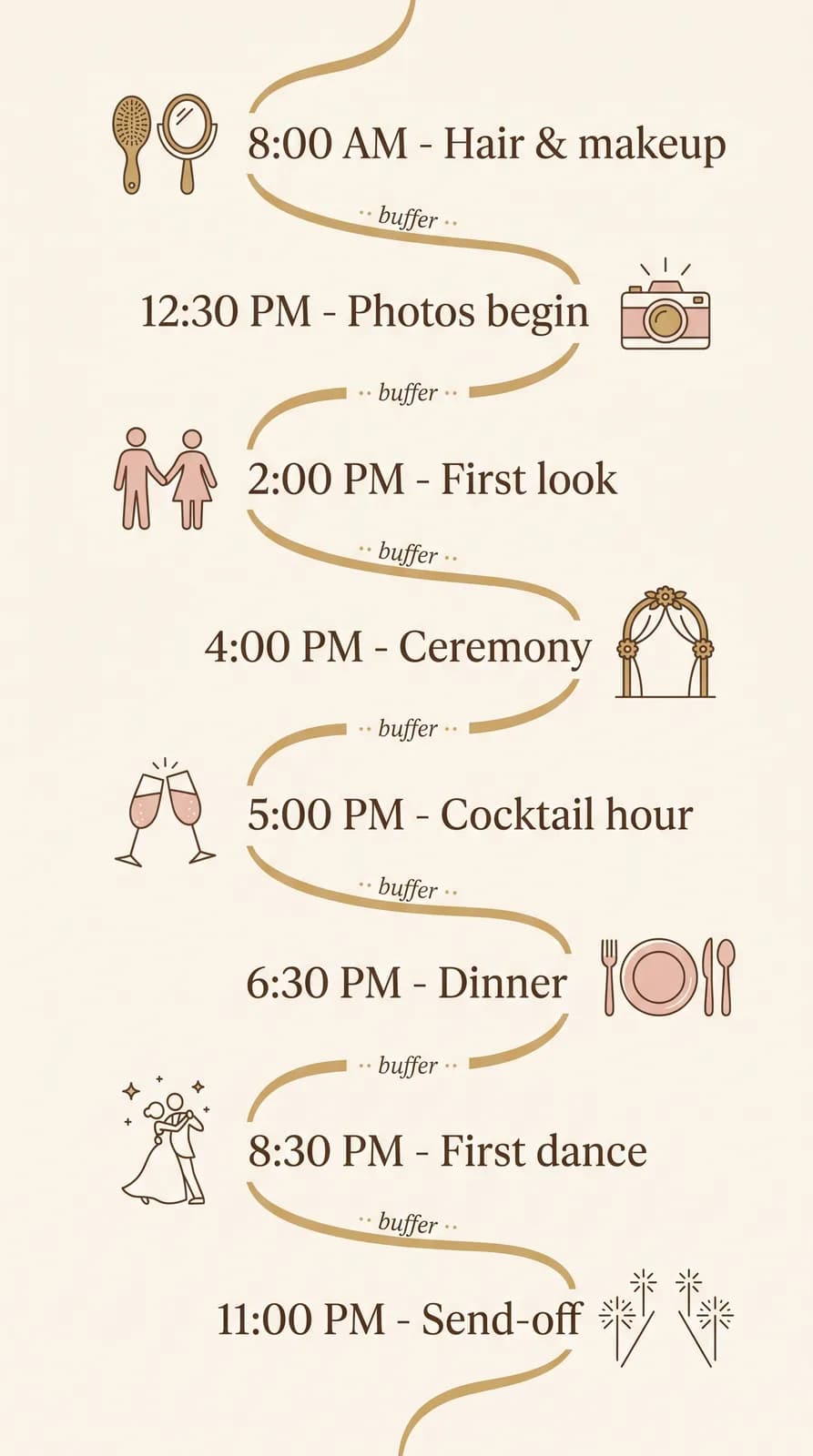
| Time | What happens |
|---|---|
| 8:00 | Breakfast. A real one, not three grapes and a mimosa. |
| 8:30 | Hair and makeup starts |
| 11:30 | Photographer arrives for detail shots (dress, rings, invitations) |
| 12:00 | Lunch gets delivered. Assign this job to someone today. |
| 12:45 | Into the dress. Allow 30 minutes, not 5. |
| 1:15 | Buffer. Fifteen minutes of nothing. On purpose. |
| 1:30 | Travel to the first look spot |
| 2:00 | First look and couple portraits |
| 2:30 | Wedding party photos |
| 3:00 | Family formals |
| 3:30 | Everyone hides, guests arrive, you breathe |
| 4:00 | Ceremony |
| 4:30 | Buffer. Hugs, happy tears, locating your dad's glasses. |
| 4:45 | You actually attend your own cocktail hour |
| 5:30 | Guests move to dinner |
| 5:45 | Grand entrance and first dance |
| 6:00 | Dinner service begins |
| 7:15 | Toasts, slotted between courses |
| 8:00 | Golden hour portraits, 20 minutes, fiercely guarded |
| 8:30 | Dance floor opens |
| 9:45 | Cake cutting |
| 11:00 | Last dance and send-off |
The times shift with your ceremony, but the shape holds. The Knot's planner-built version of a 4 p.m. ceremony timeline follows the same skeleton, and Zola's example runs a comparable arc from 8 a.m. to an 11:30 p.m. farewell.
One thing this table hides: your vendors started hours before you did. Bands need 3 to 4 hours of setup, beauty teams arrive with 30 minutes of unpacking to do, and venue load-in can begin 8 hours before the ceremony. You don't manage that, but your venue coordinator does, which is one more reason they get the full schedule early.
Want this timeline filled in for your ceremony time?
Our free generator builds your wedding day schedule backwards from your ceremony, buffers included.
Try the free timeline generatorWhat if your day looks different?
No first look
Skipping the first look is a legitimate choice. It just moves roughly 90 minutes of photos to after the ceremony: couple portraits, family formals and full wedding party shots all land in cocktail hour.
Planner Keith Willard, quoted by The Knot, estimates couples in this setup get about 20 minutes of their own cocktail hour. If that stings, extend cocktail hour to 90 minutes or shoot each side of the wedding party separately before the ceremony.
One seasonal warning. For fall and winter dates, a 4 p.m. ceremony without a first look can mean your couple portraits happen after dark. Check the sunset time before you commit to tradition, or move the ceremony earlier.
Church ceremony, separate reception venue
Now you have a travel gap. Zola's advice is to keep it between 45 and 90 minutes; past two hours, guests scatter to hotel bars and some never fully return. Double whatever Google Maps says, because a 12-minute drive with 80 guests, a shuttle and a parking garage is a 30-minute drive.
The brunch wedding
Ceremony at 11:00, lunch reception, done by 4:00. Lovely, cheaper, and brutal in exactly one way: hair and makeup starts around 5:30 a.m. Warn your bridal party before they say yes to this.
How long everything takes in real life
Every number below comes from planners and photographers who time this for a living, not from optimism.
| Block | Realistic duration |
|---|---|
| Hair and makeup, bride | 2 to 3 hours total |
| Hair and makeup, per bridesmaid | 30 min makeup + 45 min hair |
| Getting into the dress | 15 to 30 min |
| First look with portraits | 20 to 30 min |
| Wedding party photos | 20 to 30 min |
| Family formals (8 to 10 groupings) | 30 to 45 min |
| Civil ceremony | 10 to 15 min |
| Secular ceremony | 20 to 30 min |
| Religious ceremony | 25 to 45 min |
| Full Catholic Mass | 60 to 90 min |
| Cocktail hour | 60 min, 90 max |
| Plated dinner, 3 courses | 75 to 120 min |
| Buffet dinner | 60 to 90 min |
| Each toast | 3 to 5 min |
| Golden hour portraits | 15 to 20 min |
A few of these deserve a closer look. Bridal hair and makeup totals 2 to 3 hours according to The Knot's beauty timeline, and a party of six can take the beauty team 5 to 6 hours. Ceremonies range from a 10-minute civil exchange to a 90-minute Catholic Mass, so the same "4 p.m. ceremony" can mean wildly different dinner times.
For dinner, plated service takes longer than a buffet but makes toasts easier to schedule, since everyone eats at the same time. And speeches: the ideal toast runs 3 to 5 minutes, and audiences fade after five. Cap your speakers. Lovingly, but cap them.
Good to Know
Golden hour is the 30 to 45 minutes before sunset, and photographers agree it produces the most relaxed portraits of the day. Check your date's sunset time, block 15 to 20 minutes just before it, and tell your DJ that nothing else happens then.
The blocks nobody puts on the schedule
Some things happen at every wedding and appear on no wedding day schedule. Plan for them anyway.
Surprise speeches. An uncle will feel moved. A college roommate has prepared something. Each unplanned speaker costs 5 to 10 minutes, so decide in advance who speaks and tell your DJ the list is final. Route volunteers to the rehearsal dinner.
The processional rush. Nerves make everyone walk faster than they did at rehearsal, according to planner Keith Willard. Your carefully chosen song ends with half the party still in the aisle, or everyone arrives before the first chorus. Remind them the night before: slower than feels natural.
The family photo roundup. Photographer Alex Kaplan describes it well: Aunt Carol can't find her shoes and Dad needs five minutes to track down his glasses. With a big family, just assembling each grouping takes 10 to 15 minutes. Print a shot list and deputize one loud cousin per side to fetch people.
Travel, always travel. Photographers joke that wedding-day traffic obeys different physics. It doesn't, but shuttle loading, elevators and gravel paths in heels do. Double every travel estimate.
Eating. Schedule your own meals like vendor arrivals. Couples forget to eat at a startling rate, and no one enjoys their first dance on two grapes and adrenaline.
Why every wedding day timeline runs late
Here is the mechanism, because once you see it you can defend against it. Your ceremony time is fixed. Dinner is fixed, because the caterer fires the ovens on a schedule. The venue's end time is contractual.
So when the morning runs 40 minutes long, that time has to come out of something flexible. There is exactly one flexible block: your photos. Photographer Zoe Larkin puts it bluntly: the couple portraits you budgeted for are the only thing that shrinks.
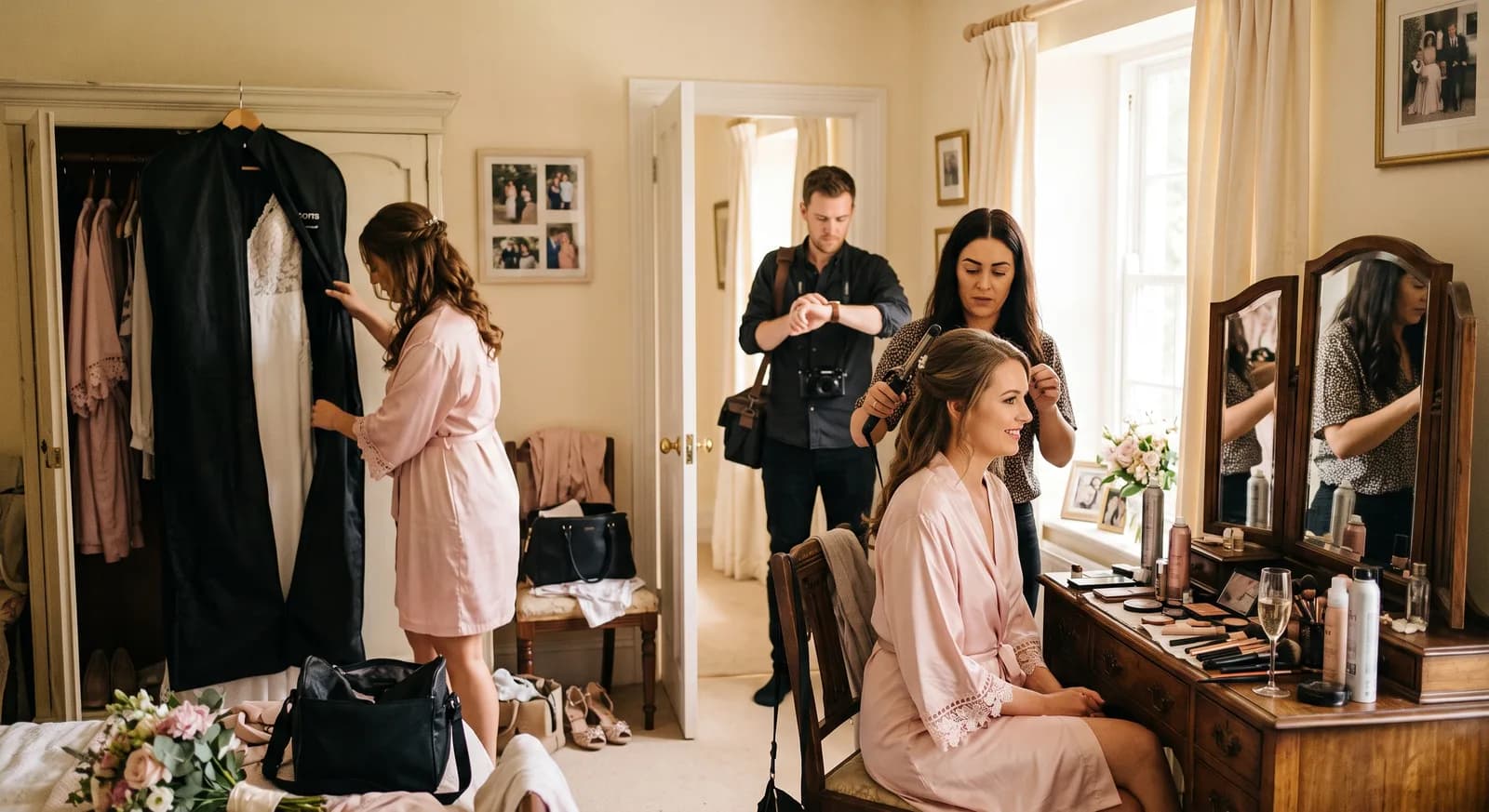
Her case files read like a sitcom. A bride doing her own makeup lost nearly an hour to false lashes. The bouquet gets left in the hotel room so often she now checks for it herself. And in her words, "it is always the boob tape."
The defense is boring and it works: start hair and makeup 30 minutes earlier than the artist suggests, put a buffer after the ceremony, and treat those buffers as appointments.
"The couples who feel the most relaxed during their photos are almost always the ones who had time they didn't end up needing."
— Alex Kaplan, Wedding Photographer
Give the schedule a bodyguard
A timeline nobody enforces is a suggestion. Someone who is not you needs to own it on the day, because you'll be busy getting married.
If you have a coordinator, this is the core of their job. If not, appoint your most cheerfully bossy friend and hand over the master schedule. Send vendors a draft 4 to 6 weeks out and the final version two weeks before the day. That gives your photographer and caterer time to flag collisions while they're still cheap to fix. Keeping the master copy in a shared place like Amovera's task manager beats seven WhatsApp threads and a PDF named "FINAL_v3_REALLYFINAL".
Important
Give guests the key times only: ceremony, dinner, party. A guest holding a minute-by-minute plan becomes a referee, and at 4:10 someone will loudly note that you're behind schedule. You'll be running late in peace.
Questions couples actually ask
What time should a 4 p.m. wedding end?
Between 10:30 and 11:00 p.m. for most couples. A standard reception runs 4 to 4.5 hours after a cocktail hour, and many venues have an 11 p.m. music curfew anyway.
What time should hair and makeup start for a 4 p.m. ceremony?
Around 8:30 a.m. for a party of four to six people, earlier for bigger groups. Work it out backwards: dressed by 1:15, bride's finishing touches done an hour before that, then count roughly 75 minutes per person shared across your stylists.
How long should cocktail hour be?
Sixty minutes is the standard. Ninety works if you're taking photos during it, but past that guests get hungry and start eyeing the exits, according to Wedding Spot.
How much time between ceremony and reception?
At the same venue: none needed, cocktail hour bridges it. At different venues: 45 to 90 minutes including travel. Anything over two hours needs entertainment plans, or you'll lose guests to naps.
Should we do a first look?
If you want to attend your own cocktail hour, yes. A first look moves most portraits before the ceremony and absorbs morning delays. If tradition matters more to you, skip it and extend cocktail hour instead. Both are valid, and only one involves your guests waiting while you shoot 40 family combinations.
How many hours of photography coverage do we need?
Eight hours covers most single-venue weddings: from the end of getting ready through the start of open dancing. Book ten if you want the full morning and the send-off, or if there's travel between venues. Nobody has ever framed a photo of hour four of the dance floor.
Steal the shape, then make it yours
Anchor the ceremony, check the sunset, work backwards, print the buffers. That's the entire method, and it's more than most couples have taped to the fridge.
Your version will differ, and it should. Weddings with a Catholic Mass, a tea ceremony or a 90-guest shuttle operation each bend the shape their own way. If the whole thing still makes your chest tight, read our piece on why wedding planning feels so stressful. Then hand the math to the free timeline generator and go taste some cake.
Plan the whole day, not just the timeline
Guest list, budget, tasks and your wedding day schedule, together in one calm place.
Get Started