
Your venue decides more than any other wedding choice. It locks in your date, caps your guest list, sets the style, and eats the biggest slice of your budget. Yet most advice on how to choose a wedding venue boils down to "start early and trust your gut."
This guide gives you the actual process: step by step from a blank page to a signed contract, with the real numbers, the questions that matter on a tour, and a simple method for deciding when two venues both feel right.
According to Bridebook's 2026 UK report, couples spend almost two years planning, but 79% book their venue within four weeks of first contacting one. The hard part is starting the search with the right numbers in hand. So start there.
Start With Three Numbers, Not a Venue Tour
Falling in love with a venue before you know your budget is the classic mistake. It works exactly as well as house hunting without a mortgage limit. Before you open a single venue website, pin down three numbers.
Your total wedding budget. Venue and catering together typically swallow 40 to 50% of it. The Knot's 2026 Real Weddings Study puts venue and rentals at 29% of the average budget, with catering, cake and drinks adding another 24%. If you haven't set a total yet, our free wedding budget calculator gives you a realistic starting point in a few minutes.
A rough guest count. Not the final list, just a realistic range. Guest count is the single biggest cost lever you have, and it's not linear. The Knot's data shows couples with up to 50 guests paid an average of $6,500 for their venue. At 101 guests or more, that jumps to $16,000. Cutting 20 names can save you more than switching venues ever will. A guest list tool helps you get to that range without endless spreadsheet versions.
Two or three date windows. Flexibility here is worth real money. A Friday typically costs 10 to 20% less than a Saturday, and off-season months can knock 15 to 30% off venue costs. If you only have one non-negotiable date, you'll pay for it in both price and availability.

What a Wedding Venue Really Costs
Here's where it gets messy. The Knot says the average US couple spent $12,900 on their venue in 2025. Zola says $8,573. Both are right.
The gap exists because "venue" means different things in different contracts. In The Knot's data, only 7% of venue fees cover just the space. About 74% include rentals like tables and chairs, 41% include catering, and 37% include alcohol. Two venues quoting $10,000 can be thousands of dollars apart once you add up what's actually included.
Ignore averages and compare venues on one normalized number: the true cost per guest. Add the rental fee, the food and beverage minimum, the service charge, and any required extras. Divide by your guest count. Suddenly the "expensive" all-inclusive venue and the "cheap" blank-space venue become comparable.
One more reason to do this math early. In July 2025, TheWedStay called 100 venues across 10 states posing as an engaged couple. Final quotes came in 112% above the advertised "starting at" price on average. A venue listed at $4,200 quoted $8,930 once real numbers were on the table. Only 12% of venues gave transparent pricing upfront.
Important
The 18 to 25% "service charge" on your quote is usually not the staff tip. It's the venue's operational fee, and it's often taxed on top. Ask what it covers and whether gratuity is separate.
Keep every quote in one place as you collect them. A budget tracker with all venue costs side by side saves you from digging through a folder of quote PDFs when you're comparing three finalists at 11pm.
Keep every venue quote in one place
Track quotes, guest counts and payments side by side, and see what each venue really costs.
Get StartedYour Venue Search Timeline
Most couples book their venue 12 to 18 months before the wedding, which matches how far ahead the good dates disappear.
Here's a working timeline:
- 18 to 14 months out: Set budget, guest range and date windows. Build a shortlist of 8 to 12 venues online.
- 14 to 12 months out: Email your shortlist, collect quotes, and cut the list to 3 to 5. Tour those.
- 12 to 10 months out: Compare, review the contract, and book.
Adjust for your situation. A Saturday in June, September or October at a sought-after venue can require 18 to 24 months of lead time. A January wedding, or a Thursday, might come together in 6 months with plenty of choice left.
Good to Know
Popular venues don't fill up evenly. Peak Saturdays go 18+ months out while off-season dates at the same venue sit open. If your heart is set on a specific place, ask which dates they still have before you rule anything out.
Shortlist First, Tour Later
Couples who tour eight or ten venues report the same thing: the details blur together and every ballroom starts looking the same. Three to five tours is the sweet spot, and you get there by screening hard over email first.
Send every shortlisted venue the same three requests:
- Your specific date windows and whether they're available
- A line-item quote for your exact guest count, including all mandatory fees
- A sample contract
This does double duty. You get comparable numbers, and you get a preview of how the venue communicates. A venue that takes a week to reply to a sales inquiry, dodges pricing questions, or won't share a sample contract is showing you exactly how they'll behave after they have your deposit.
Wedding forums are full of couples who chose the objectively "worse" space because the coordinator at the prettier venue kept changing agreed details. They were right to. On your wedding day, a reliable venue manager beats a prettier staircase.
The Venue Tour: Questions That Actually Matter
The Knot publishes a list of 64 questions to ask a wedding venue. Nobody asks 64 questions in a 45-minute tour. Prioritize instead: dealbreakers first, money second, logistics third.
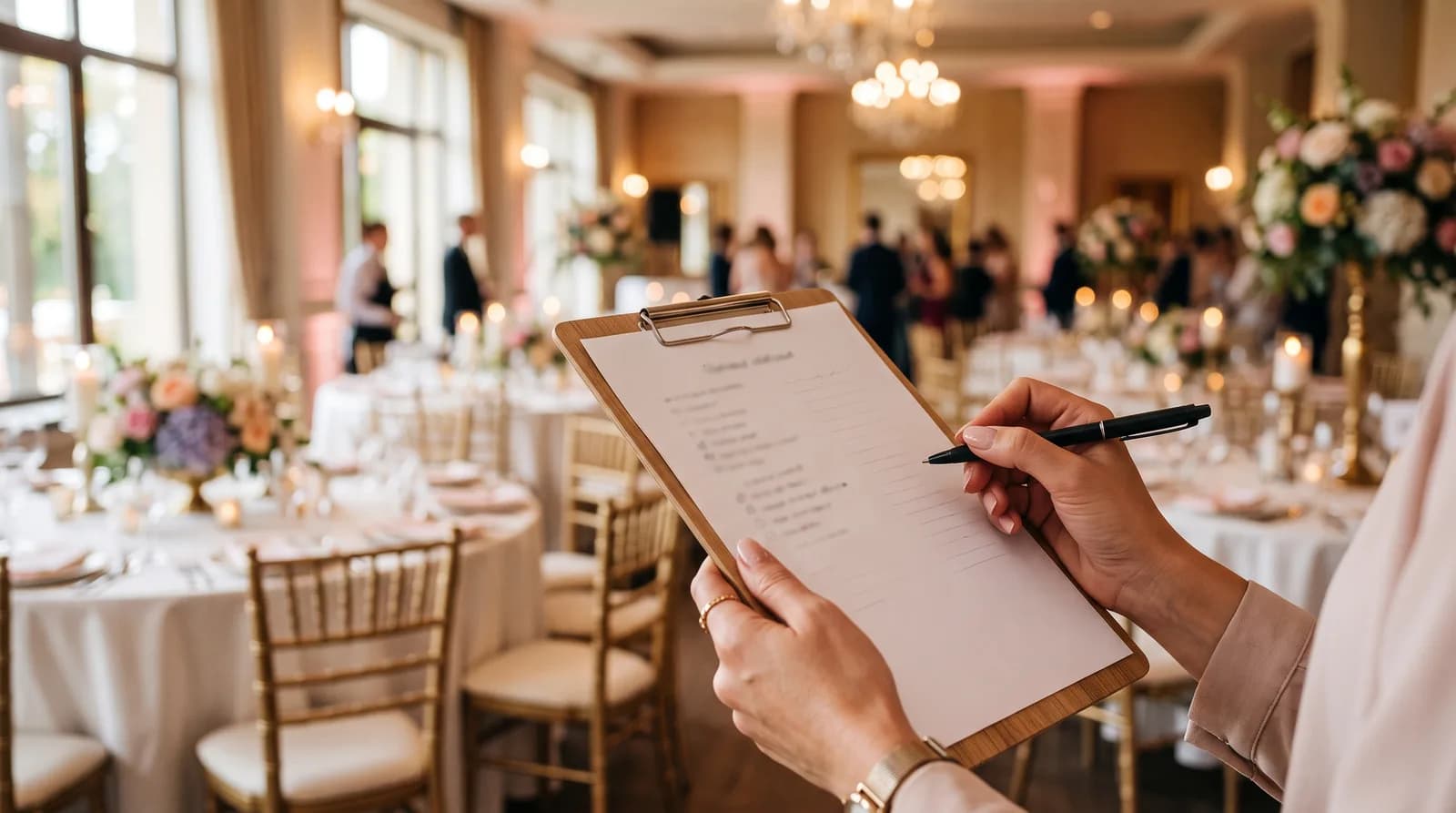
Dealbreakers. Ask these before you fall in love:
- What's the real capacity, seated with a dance floor? "Max 300" often means cramped at 250. Seated dinners need roughly 15 square feet per guest; standing receptions need about 6.
- What's the rain plan, and can we see it today? A tent over the parking lot is not a plan B you'll love.
- What time must the music stop, and what does overtime cost?
- Are we the only event that day, or do you run parallel functions?
- Which vendors are we required to use, and what's the fee for bringing our own?
Money questions:
- What exactly does the fee include: tables, chairs, linens, setup, teardown, a day-of coordinator?
- Is there a food and beverage minimum, and does it include tax and the service charge?
- What are the fees for cake cutting, corkage, and outside vendors? Mystery-shop data puts cake cutting at $2 to 5 per person and corkage at $15 to 25 per bottle, so these add up fast at 120 guests.
Logistics:
- How many restrooms are there? A workable baseline is one per 50 guests, more when there's a full bar.
- Where do guests park, and is it free?
- Are there hotels within 30 minutes, or do we need a shuttle?
Pro Tip
Tour at the hour of your actual reception, not at noon on a Tuesday. Light, temperature and noise change completely between 12pm and 7pm, and couples regularly regret booking a space they only saw in daylight.
For the outdoor question specifically, Miami planner Jessyca Canal gives the cleanest rule:
"Couples should see Plan A and Plan B during the venue tour, and they should love both."
— Jessyca Canal, EBJ Events
How to Decide Between Two Venues
Sooner or later you'll be stuck between two finalists that both tick the boxes. This is the most common venue thread on every wedding forum, and "go with your gut" is a coin flip wearing a nicer outfit. Do this instead.
First, normalize the cost. Work out the true cost per guest for both venues: rental plus food and beverage minimum plus service charge plus required extras, divided by your guest count. A $7,000 venue with a $12,000 catering minimum and a 22% service charge is not cheaper than a $15,000 all-inclusive. Couples find this out in month eleven. You'll know it now.
Second, score what matters to you. Pick your five most important criteria: say, guest experience, style, food, flexibility, and how much the coordinator earned your trust. Weight each one out of 10, score both venues, and multiply. It takes twenty minutes and it forces the conversation you and your partner actually need to have: which of these things do we care about most?
Then let your gut break the tie. If the scores land within a few points of each other, the venue you keep picturing yourselves in wins. Gut feeling makes a great tiebreaker once the math is done.
One number worth keeping in mind while you decide: in one survey of newlyweds, the venue was the top spending regret, with 36% wishing they'd spent less on it. Nobody seems to regret the cheaper venue where everyone danced until the lights came on.
Before You Sign: The Contract Checklist
The tour sells you the venue. The contract is what you actually buy. Before any deposit leaves your account, check these eight points:
- Deposit and payment schedule. 10 to 30% down is standard, almost always non-refundable. Note when the balance is due and when they need your final headcount.
- Cancellation and postponement terms. What do you get back at 12 months out, 6 months, 30 days? Is postponing treated differently from cancelling?
- What happens if the venue cancels, closes, or changes ownership before your date. This clause matters more than couples think.
- The food and beverage minimum, and whether tax and service charge count toward it.
- The hard end time and the overtime rate. Overtime commonly runs $150 to 300 per hour.
- Vendor clauses. Required vendor lists, outside-vendor fees, and insurance requirements for your suppliers. Keep these details with your vendor notes so nothing surfaces two weeks before the wedding. A vendor management tool makes that easy.
- Exactly what's included, listed item by item: tables, chairs, linens, staffing levels, setup and teardown windows.
- Every verbal promise, in writing. "The coordinator said we could" has no legal weight. If it was promised on the tour, it goes in the contract.
If a venue resists putting any of this in writing, you've learned something valuable at the best possible time.
FAQ: Choosing a Wedding Venue
How many wedding venues should you tour?
Three to five. Screen your longer list by email first, using quotes and availability. Touring more than six venues consistently leads to decision fatigue, where the visits blur together and comparisons get harder, not easier.
How far in advance should you book a wedding venue?
Twelve to 18 months for most couples, and 18 to 24 months for peak-season Saturdays at in-demand venues. Off-season dates (January to March) often work with 6 to 9 months of lead time.
Is it cheaper to get married on a Friday or off-season?
Yes. Fridays and Sundays typically run 10 to 20% below Saturday pricing, and off-season months can cut venue costs by 15 to 30%. One caveat: weekday weddings see slightly lower attendance, mostly from out-of-town guests.
What is a food and beverage minimum?
The amount you're contractually required to spend on catering and drinks, separate from the rental fee. Always ask whether tax and the service charge count toward it. If they don't, the real minimum is 25 to 30% higher than the number in the brochure.
What's the biggest mistake couples make when choosing a venue?
Falling in love with a space before locking their budget and guest count. Everything else follows from those two numbers, and stretching either one to fit a venue is how the venue becomes the top spending regret among newlyweds.
The Short Version
Set your budget, guest range and date windows before you look at a single venue. Screen by email, tour three to five at the hour of your actual event, and compare them on true cost per guest instead of the advertised price. Then read the contract as closely as you looked at the space.
Do that, and the four weeks between first inquiry and signed contract will feel like the natural end of a process you controlled. If the planning stress still creeps in, you're in good company: we wrote about why wedding planning feels so stressful and what helps.