

You sit down to design the RSVP card and there it is. The dietary question. You want to ask, because half your guest list eats differently than they did five years ago. Every wording you try sounds like a clipboard at a hospital intake.
Most couples react in one of two ways. They skip the question entirely and hope for the best. Or they staple on a wall of checkboxes that makes Aunt Linda feel like she's filling out a tax form. Both options leave money on the table and put guests on the spot.
There's a third way. You can ask kindly, get clean data, and hand your caterer a sheet they can actually work with. The trick is knowing what to ask, where to ask it, and how to phrase it so the guest with a quiet shellfish allergy actually mentions it.
Why this matters more than couples think
The numbers are louder than you'd expect. Around 22 million Americans live with a diagnosed food allergy, and 31% of US adults report some kind of allergic condition each year. About one in ten adults globally has a food allergy. Roughly the same proportion of your wedding will eat differently than the headcount on your invitation.
A 100-person wedding will have at least a dozen guests who can't eat a standard dish. Some will tell you. Some won't, because they don't want to be a hassle. Your job is to make telling you the easy choice.
The cost of getting this wrong is concrete. Plated dinners run $65 to $200 per person in the US, with an 18 to 22% service fee on top. Final headcount is due to your caterer 10 to 14 days before the wedding. If three serious allergies surface the morning of, your kitchen has no time to react. Ten plates billed and not eaten can torch around $2,000 once service is added.
Good to Know
An allergy and a preference look identical on paper, but they cost the kitchen very different amounts of effort. Knowing which is which is where most RSVP forms fall apart.
Three rules for asking without making it weird
1. Ask everyone, not just "the vegetarians"
The instinct is to ask the cousin you know is vegan and skip the rest. Don't. The weirdness comes from singling people out. The fix is to ask every single guest the same questions on the same form, treating it as a routine field, not a personal interrogation.
When everyone fills it in, nobody feels flagged. The vegan in your family becomes one entry among many, not a special case the kitchen has to remember. The guest with a mild shellfish issue who would have stayed quiet now has a no-fuss place to mention it.
2. Separate allergies from preferences
These two need different treatment, both in your form and in your caterer's kitchen.
A nut allergy or celiac diagnosis is medical. The kitchen needs dedicated surfaces, separate utensils, and staff who know which plate is going to which seat. A pescatarian guest just needs a different protein. Same form, same RSVP, very different protocols behind the scenes.
If you mash these together under "dietary restrictions," the form gets ambiguous and your caterer guesses. Two clean fields fix it. One labeled "allergies or intolerances," one labeled "dietary preference."
It's very important to make sure you know of any allergies or restrictions so that the caterer can accurately prepare and ensure that all guests will be taken care of.
— Elena Markwood, Adoration Weddings & Events
3. Make it opt-in detail, not a forced checkbox
If your form forces every guest to pick one of fifteen labels, you'll get noise. People without restrictions tick "no preference" or skip the field. People with real needs sometimes pick the wrong box because it's faster.
Better: a short yes/no first ("any food allergies or dietary needs we should know about?"), and only if they say yes, surface the detail. The form stays short for the 80% of guests who don't need it, and gets specific for the 20% who do.
The wording that works
You don't have to invent this. Couples and stationers have been refining the phrasing for decades. Here are five examples that sound natural and pull clean answers, ranked from softest to most specific.
Soft and human:
"We'd love to make sure you're comfortable. Let us know if we can accommodate any food needs."
Friendly and direct:
"Please let us know if you have any allergies or dietary restrictions!"
Specific without being clinical:
"Any special meal requests or food allergies we should know about?"
Two-step, with detail capture:
"Do you have any food allergies or dietary restrictions? (Yes / No). If yes, please specify."
Severity-aware (for plated dinners with allergies):
"How severe is your allergy? (Mild / Moderate / Severe)"
The middle three handle most weddings. The severity question matters when you're doing a plated dinner and your caterer needs to plan kitchen separation. Mild lactose discomfort and a true anaphylactic nut allergy are both "allergies," but only one needs the kitchen on alert.
Where to ask: RSVP card, wedding website, or email?
All three feel reasonable until you trace the data flow.
Paper RSVP card. One line, one shot. Whatever the guest writes is what you have. Handwriting can be illegible. There's no follow-up if they leave it blank. Plus-ones rarely get their own line, which means the +1 with a peanut allergy never disclosed it.
Wedding website only. Better fields, but only a fraction of guests actually visit. You'll have RSVPs sent, dietary info missing, and no easy way to chase the gaps.
Follow-up email. Lowest response rate of all three. Guests have already mentally moved on after sending the RSVP.
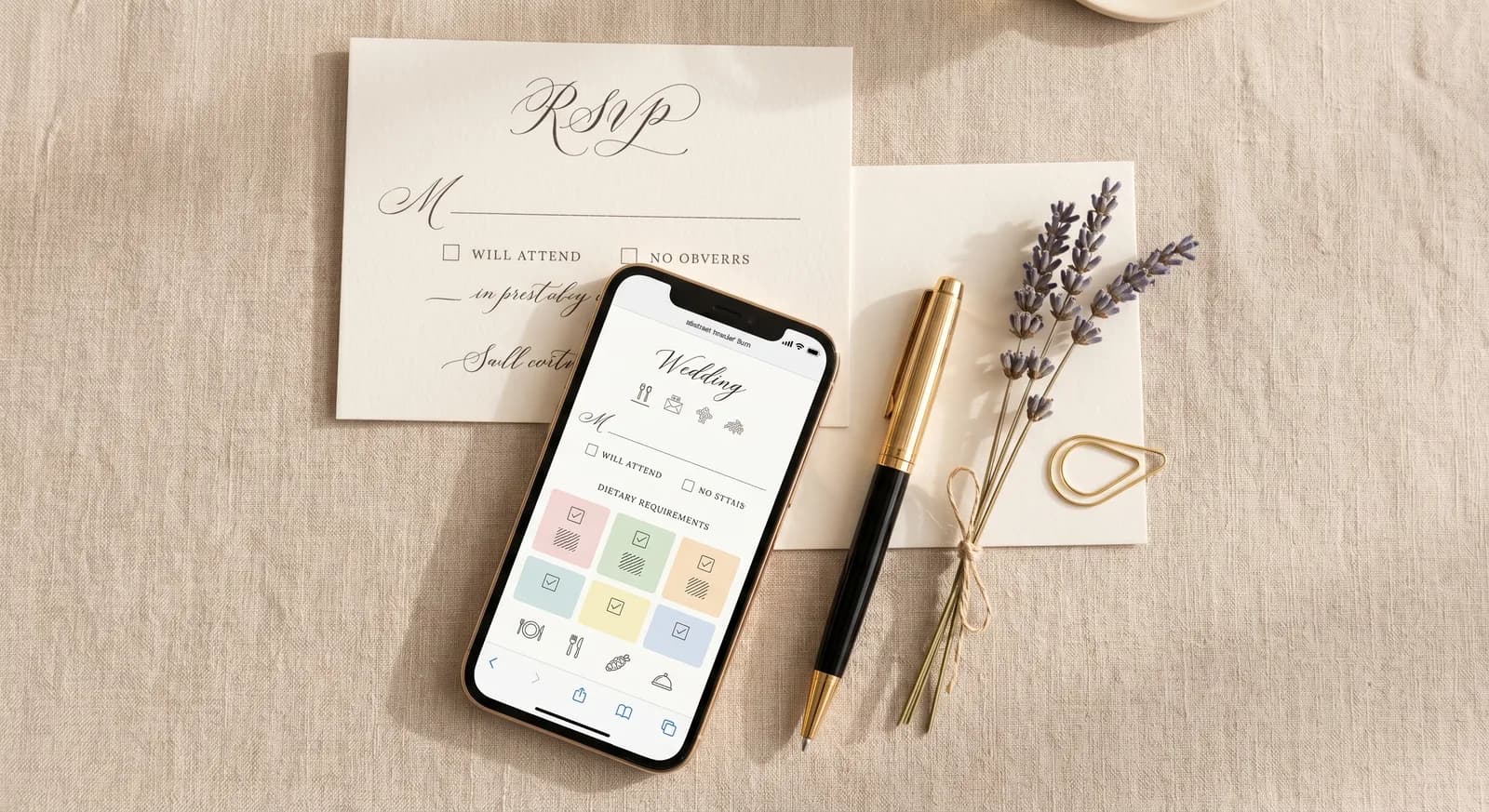
The form that works best is a structured digital RSVP where dietary fields live next to the "yes I'll attend" button. Guests answer both at the same time, and each guest in the party fills in their own fields, including the plus-one. The data lands in one place, ready for the caterer.
We have a more detailed comparison in our online RSVP vs paper invitations breakdown if you want the full cost and response-rate side-by-side. There's also a separate piece with 25 RSVP wording examples if you want a longer phrasing list.
See how Amovera collects dietary info
Per-guest fields, fifteen built-in categories, and a clean export for your caterer.
Explore Guest ListWhat to actually collect
A useful RSVP form, dietary section included, has these fields per guest:
- Name of the specific guest, not just the inviting party.
- Attending status: yes, no, or maybe.
- Dietary preference: vegetarian, vegan, pescatarian, halal, kosher, no pork, no beef, low sodium, diabetic, pregnant, or "no preference."
- Allergies or intolerances: free text, with a follow-up severity selector (mild, moderate, severe) if anything is entered.
- Plus-one details: the same fields, repeated for the plus-one if one is invited.
The point of separating preference from allergy isn't bureaucratic. Your caterer reads them differently. The vegetarian list goes to the menu planner. The allergy list goes to the head chef.
Important
A guest writing "lactose intolerant" doesn't always mean kitchen-level avoidance. Some guests are fine with butter; some need every dairy molecule removed. A severity selector lets them tell you which they are without an awkward email.
Why paper RSVP cards fall short
Paper has its charm, but it loses the dietary battle on three fronts. Roughly 35 to 45% of paper RSVPs never come back at all, compared to 85 to 95% for digital. Even when they do come back, you're decoding handwriting, chasing missing plus-one data, and re-typing fields into a spreadsheet.
The math is that for every ten paper RSVPs you mail, four come home incomplete or never arrive. You'll spend the last month before the wedding making phone calls to people who are also stressed.
A structured digital RSVP avoids most of this. Required fields where they matter. Data already in a usable format. Guests can update their answer if their situation changes. The full comparison sits in our online RSVP vs paper post.
The digital flow that does the awkward work for you
This is where Amovera's Guest List feature was built to help. You send each guest a unique RSVP link, often through WhatsApp or email. They see fields tailored to them. Each member of the party, including the plus-one, fills in their own preferences and allergies. The responses come in live.
Fifteen common dietary categories are built in, so you don't have to design the form from scratch:
Built-in dietary categories
Vegetarian, vegan, pescatarian, gluten-free, dairy-free, nut allergy, shellfish allergy, halal, kosher, no pork, no beef, low sodium, diabetic, pregnant, and other.
Guests pick what applies. The data is per-guest, not per-invite, which means the cousin's plus-one with a shellfish allergy is captured even if you've never met them. When you brief your caterer, you have a clean count by category, with names attached.
You also see in real time which RSVPs are still missing dietary fields and can send a quick nudge through the same channel you used to invite them.
Communicating with your caterer
Most caterers want the information four to six weeks before the wedding, with a final reconfirmation 10 to 14 days out. Send it once, then send the diff later.
A useful first message has three things: the headcount by dietary preference (e.g., "78 standard, 12 vegetarian, 4 vegan, 2 pescatarian"), the named allergy list with severity, and any religious requirements that affect ingredients or cross-contamination, such as halal or kosher.
Pro Tip
Send your caterer a simple table, not a paragraph. One row per guest with a restriction, columns for name, table number (if you know it), preference, allergy, and severity. That's the format kitchens already use. They'll thank you.
Reconfirm the headcount and any late updates two weeks before. New RSVPs trickle in until the last minute. The fewer surprises on cooking day, the safer the meal service.
Edge cases couples actually hit
A few situations come up over and over:
- The "no preference" guest who later mentions an allergy. Send a one-line follow-up the moment you hear it. Update the caterer, even if the cutoff has passed. Most kitchens will accommodate one or two late items if you ask politely.
- The plus-one added a week before. If your RSVP form lets the inviting guest add the plus-one's name and dietary fields directly, this resolves itself. If not, you're sending a separate email.
- The guest who lists six restrictions. Don't litigate it. Take it at face value, brief the caterer, move on. Litigating dietary disclosures with guests creates more drama than it solves.
- Religious requirements you didn't expect. Halal, kosher, and certain fasting practices need a conversation with the caterer well in advance, not on the day. Surface these on the RSVP and act on them within a week.
The short version
Ask every guest. Separate allergies from preferences. Use real wording that sounds like a person, not a hospital form. Collect the data per guest, not per invite. Forward it to your caterer in a table four to six weeks out, then reconfirm two weeks before the wedding.
The dietary question doesn't have to be weird. It's just admin, with a side of kindness, done at the right moment with the right form.