

You spent weeks choosing cardstock and wording for your wedding invitations. Now comes a different question: how should your guests actually respond?
Paper RSVP cards have been the standard for decades. You tuck one into every envelope, stamp it, and wait. But digital RSVPs are gaining ground fast. They cost less and save you from chasing down your college roommate three weeks past the deadline.
Below, you'll find real numbers for both options: printing costs, postage, platform fees, response times, and the hidden hassles nobody warns you about.
What Paper RSVPs Actually Cost
The costs are spread across a half-dozen line items that add up quickly.
Per suite (invitation + RSVP card + envelopes), you're paying for:
- RSVP card printing: $1 to $3 each for digital printing, $6 to $12 each for letterpress or engraving
- Inner and outer envelopes: $40 to $120 for 80 suites, depending on paper weight
- Outgoing postage: $1.27 per suite (USPS 2-oz letter rate, 2025)
- Return postage: $0.78 per RSVP card (standard 1-oz Forever stamp)
For a wedding with 100 guests (roughly 80 mailed suites), that totals $454 to $884. Scale up to 200 guests (about 140 suites) and you're at $957 to $1,787.
The national average spend on wedding stationery hit $518 in 2025, according to The Knot's annual survey of 17,000 couples. That number only covers what people admit to spending.
Then there are the costs that don't show up on any invoice. Reprinting after a typo. Squinting at handwriting to figure out whether your cousin wrote "vegan" or "began." And the hours you'll spend texting guests who never mailed their card back.
What Digital RSVPs Cost
The price range is dramatically different.
| Platform | Cost |
|---|---|
| Joy, Zola, The Knot | Free (included with wedding website) |
| QuikRSVP | $35 one-time |
| Paperless Post | ~$100 for 100 guests |
| Greenvelope | $99 to $199 |
| Amovera | Included with planning tools |
For 100 guests, digital RSVPs run $0 to $100. Paper runs $454 to $884. That's $350 to $800 back in your pocket before a single guest responds.
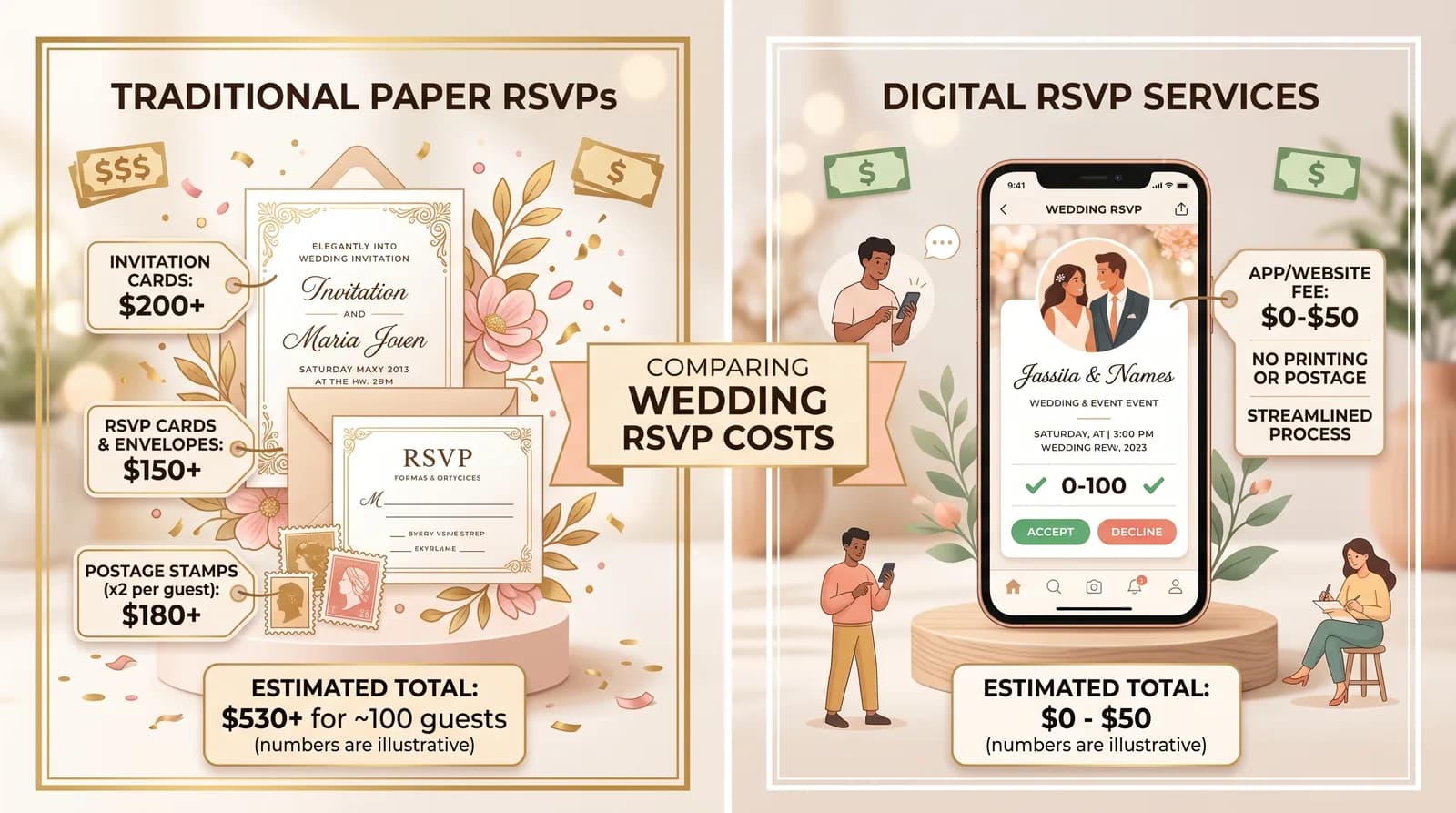
Even at the high end, digital platforms cost less than the postage alone on paper RSVPs.
Paper RSVPs: What Works and What Doesn't
Paper invitations carry a weight that a screen can't replicate. Thick cardstock with embossed lettering. Your names in calligraphy. Guests pin them to the fridge and some keep them for years.
That tactile quality matters, especially for formal weddings. A letterpress suite signals a certain kind of event before anyone reads a word.
Where paper falls short
The problems start after those envelopes leave your hands.
Standard mail has no tracking. You won't know if a card was lost, sitting in a pile of junk mail, or buried in someone's glove compartment. When the deadline passes, you're left guessing who forgot and who never received it.
Handwriting is another issue. Some couples secretly number the back of each RSVP card to match responses to their guest list, because they can't read the names people write. That workaround exists because the problem is so common.
Paper cards also can't collect structured data. You get a blank line for dietary needs, which produces answers like "no pork please" or "whatever is fine" or nothing at all. No way to capture +1 names, accessibility needs, or song requests in any organized format.
Good to Know
Pre-stamped return envelopes do boost response rates. But even with stamps included, 57.6% of guests take five or more weeks to respond. You're still waiting and chasing.
Between 20% and 40% of couples report having to follow up with non-responders, according to wedding planning surveys. That means dozens of texts, calls, and awkward conversations in the final weeks before your wedding.
Digital RSVPs: What You Actually Get
Cost savings get the headlines, but the bigger advantage is what happens after you hit send. Digital RSVPs change how you manage your entire guest list.
Speed and structure
Responses arrive in seconds, not weeks. You see who opened the link, who submitted their RSVP, and who hasn't touched it yet. No guessing.
Every response comes back in structured fields. Dietary restrictions from a dropdown, not a scrawled note. Plus-one names typed clearly. Accessibility needs captured in a format you can hand directly to your venue coordinator.
Real-time tracking
A dashboard shows attending, pending, and declined counts at a glance. You can filter by event (ceremony vs. reception) and export everything to a spreadsheet when your caterer asks for final numbers.
Automated reminders go out to guests who haven't responded. You set them once and forget about it. No more "hey, did you get our invite?" texts at 10 PM on a Tuesday.
International reach
If you have guests in different countries, digital RSVPs remove the headache of international postage entirely. A link works the same whether someone opens it in Austin or Auckland.
Environmental impact
Each paper invitation suite produces roughly 140g of CO2 when you account for paper production, printing, and two-way mailing. For 100 suites, that's 14kg of carbon. Digital RSVPs reduce that to nearly zero.
Addressing the concerns
"My older relatives won't manage." Most will. Clicking a link and selecting options from a list is simpler than filling out a form and finding a mailbox. One couple shared that their grandparents, both in their mid-80s, preferred the digital option because it was faster. For the few guests who truly can't go online, add a phone number to your invitation as a backup.
Pro Tip
Print a phone number on your invitation for guests who aren't comfortable online. You'll cover 100% of your list without giving up tracking on the other 95%.
"It feels impersonal." Your invitation can still be a beautiful printed piece. The response method is logistics, not sentiment. Nobody frames their RSVP card. They fill it out and mail it back. That step works better digitally.
"Is it proper etiquette?" Twenty-five percent of couples already use digital RSVPs, per The Knot's 2025 data. That number grows every year. Unless you're hosting an ultra-formal black-tie affair, digital responses are fully accepted.
Track every RSVP without chasing a single guest
Amovera gives each guest a unique RSVP link. Dietary needs, plus-ones, and per-event responses, all in one dashboard.
See how it worksWhat About a Mix of Both?
Some couples want the printed invitation experience but digital responses. They send paper invitations with a QR code that links to a digital RSVP form.
QR code usage on wedding invitations grew from 20% in 2022 to 49% in 2024. Guests scan with their phone and respond instantly. You get structured data and real-time tracking while your invitation suite stays as elegant as you want.
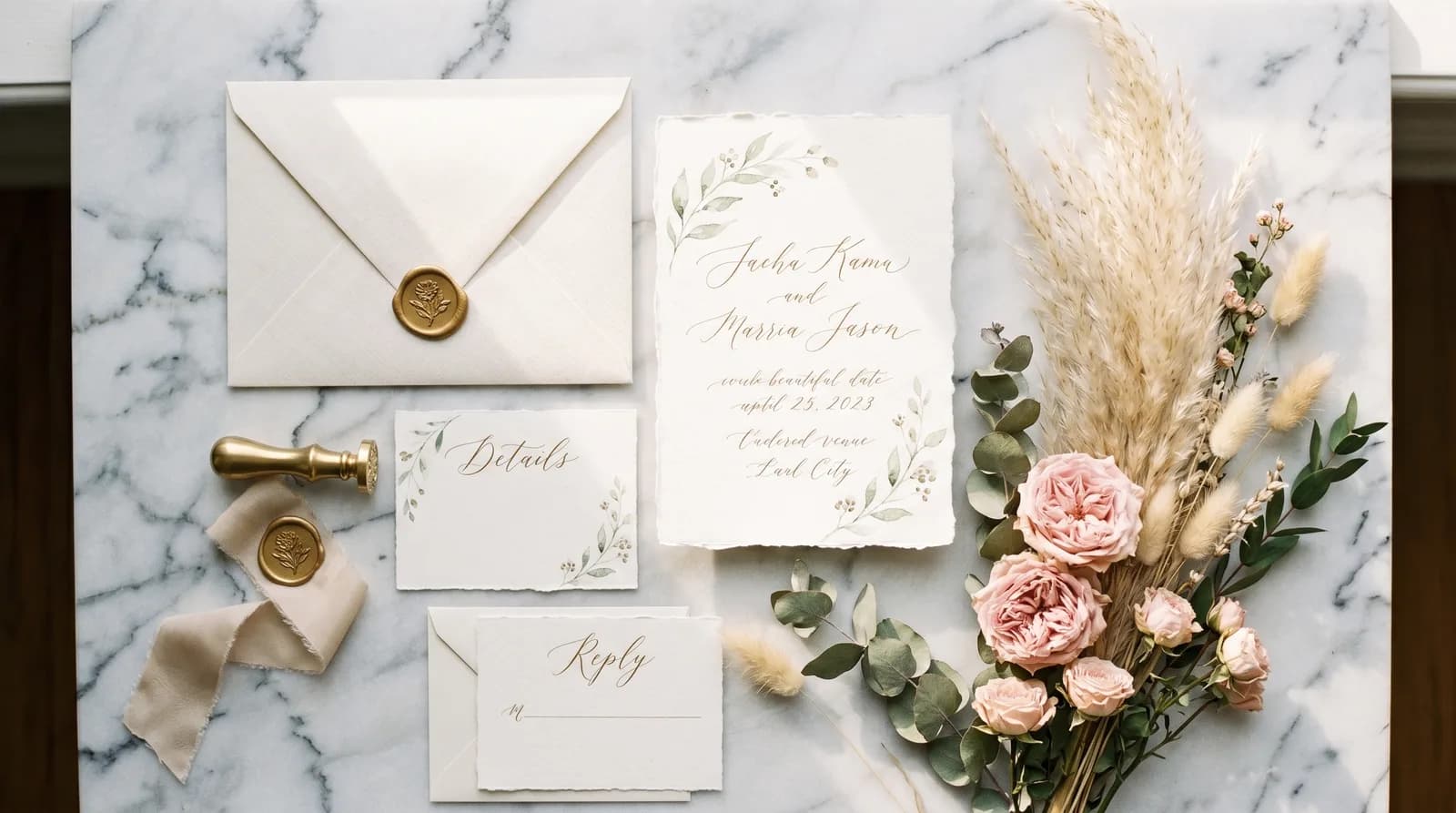
The trade-off: you're still paying for printing, envelopes, and postage. You save on return postage (no RSVP card mailed back), but the bulk of stationery costs remain. It's a valid option if the printed invitation matters to you, just not the most budget-friendly path.
Which Approach Fits Your Wedding?
Skip the debate and match the method to your situation.
Go digital if: most of your guests are under 50, your wedding is semi-formal or casual, you're planning a destination event, you want structured dietary and accessibility data, or your budget is tight.
Consider paper if: you're hosting an ultra-formal black-tie event, your guest list is very small (under 30), or your immediate family has strong traditional expectations that matter to you.
Mix them if: you love the look of printed invitations but want digital response tracking. The QR code approach gives you both, at a higher price point.
One more thing to weigh: time. Paper RSVPs lock you into a 6-to-8-week response window with manual follow-up at the end. Digital RSVPs give you answers in days and automate the reminders. That's hours of your life you get back for planning the events themselves.
You can spend your last weeks before the wedding chasing responses, or you can spend them finalizing the details that actually matter to you.
Make Your Invitations Work Harder
Paper RSVPs cost more, take longer, and give you less useful data. Digital RSVPs save money and let you track everything in real time. The choice depends on your guest list, your budget, and how much time you want to spend on logistics.
Whatever you choose, the wording on your invitation still matters. Our invitation wording generator helps you write clear, warm invitations that match your wedding's tone, whether you're directing guests to a mailbox or a link.